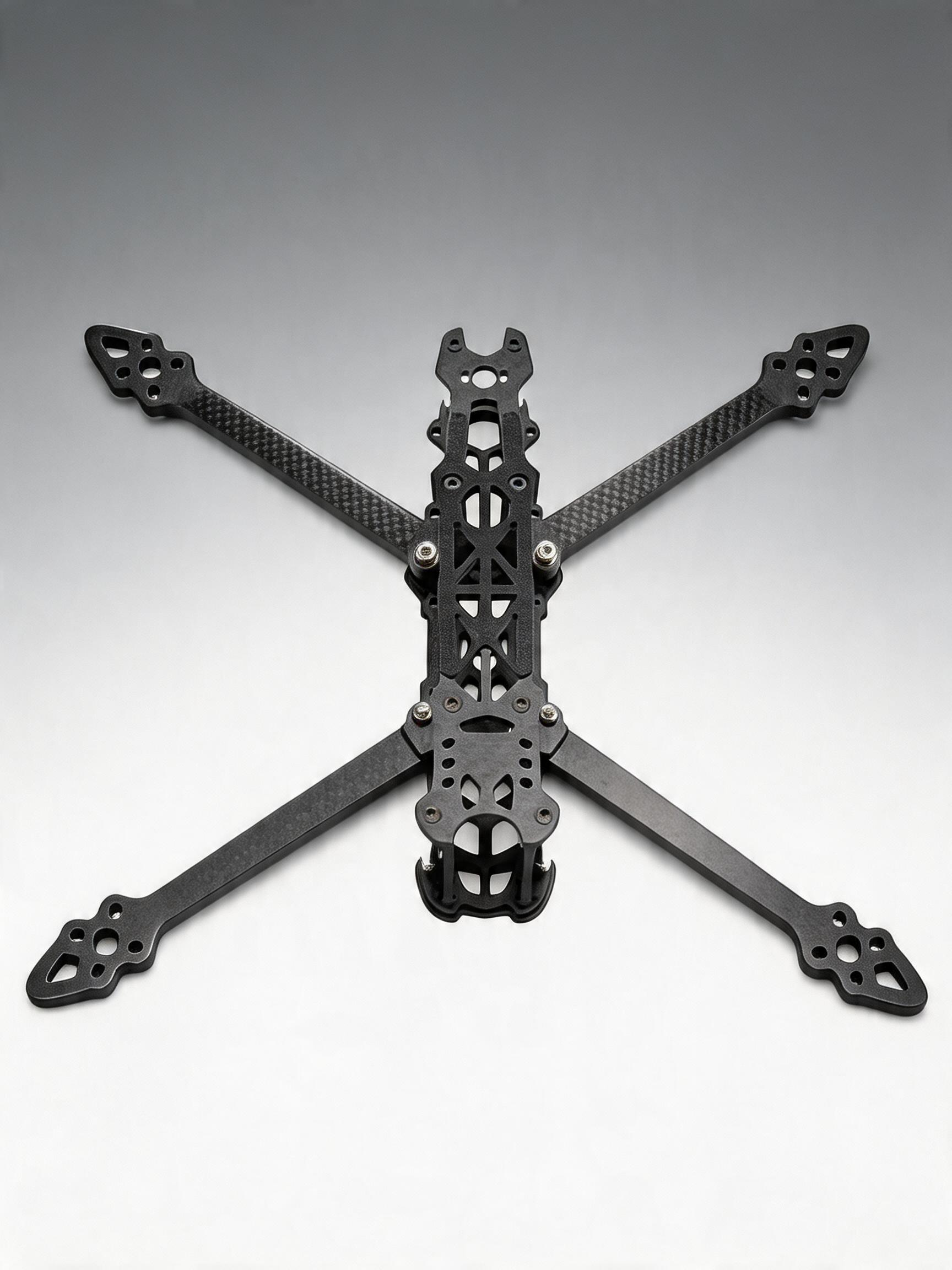
What began as a niche racing hobby has quietly transformed into the backbone of professional unmanned systems. Today, FPV Drone Parts — once associated solely with acrobatic quadcopters — are being repurposed for a new generation of air vehicles, including the High Speed Rocket Machine, the Hanging Fixed-wing Drone, and the Large Payload Unmanned Aerial Vehicle.
The catalyst for this evolution is twofold: the maturation of FPV Drone Flight Control technology and the widespread adoption of the Drone Launcher.
Breaking the Speed Barrier with Rocket Power
The High Speed Rocket Machine represents a radical departure from traditional electric propulsion. Using solid or liquid rocket motors, these platforms achieve velocities that would destroy standard multirotors. Yet they rely on the same fundamental FPV Drone Parts — miniaturized cameras, 5.8 GHz or digital video transmitters, telemetry radios, and compact receivers. What makes rocket flight possible is the FPV Drone Flight Control unit, which must now handle extreme acceleration (10–20G), rapid throttle transitions, and the complete absence of propeller-based stabilization at high Mach numbers.
Recent firmware updates to open-source FPV Drone Flight Control platforms (ArduPilot and PX4) now include dedicated rocket profiles, with launch detection, coast-phase stabilization, and recovery deployment logic. This has lowered the barrier for researchers and hobbyists alike to experiment with High Speed Rocket Machine designs using readily available FPV Drone Parts.
Launcher-Based Takeoff: The Great Enabler
No discussion of modern drone operations is complete without the Drone Launcher. Bungee, pneumatic, and electromagnetic launchers have moved from military-only to commercial availability. A Drone Launcher solves the fundamental tension between airframe efficiency and takeoff infrastructure: a wing optimized for long endurance typically has poor low-speed lift, making hand-launch or vertical takeoff problematic.
For the Large Payload Unmanned Aerial Vehicle — often exceeding 25 kg with sensors or cargo — a Drone Launcher is not a luxury but a necessity. By providing initial velocity, the launcher allows the aircraft to start flight in its most efficient regime. When combined with FPV Drone Flight Control systems featuring launch-mode logic (attitude hold, roll damping, and climb-out waypoints), operators can safely deploy heavy payloads from ships, trucks, or remote airstrips.
The Hanging Fixed-Wing Drone: Modularity Redefined
Perhaps the most innovative airframe to emerge in the past year is the Hanging Fixed-wing Drone. Unlike conventional designs where payload is buried inside the fuselage, the hanging fixed-wing drone suspends mission equipment — high-resolution cameras, LiDAR units, cargo boxes, or even sub-drones — beneath a streamlined wing. This approach offers three advantages:
Instant modularity – Swap payloads in seconds without tools.
Thermal isolation – Sensitive electronics are separated from propulsion heat.
Center-of-gravity flexibility – The hanging mass can be positioned for optimal balance.
To function reliably, the Hanging Fixed-wing Drone depends on vibration-damped FPV Drone Parts, especially the FPV Drone Flight Control unit, which must compensate for pendulum-style dynamics. Early adopters report success using standard FPV flight controllers with customized PID tuning and low-pass filters.
The Common Denominator: FPV Drone Flight Control
Across all four platforms — the High Speed Rocket Machine, the Large Payload Unmanned Aerial Vehicle, the Hanging Fixed-wing Drone, and launcher-launched conventional drones — the critical component is the FPV Drone Flight Control system. Modern flight controllers, built around STM32 or similar processors, now support:
Multiple vehicle types within a single hardware platform
Launch detection and in-flight reconfiguration
High-vibration environments (rocket boost and hanging wing oscillations)
Integration with Drone Launcher sensors (rail position, airspeed at launch)
Market Outlook
Demand for specialized FPV Drone Parts is projected to grow at 24% CAGR over the next three years, with the High Speed Rocket Machine and Hanging Fixed-wing Drone segments outpacing traditional racing platforms. Meanwhile, Drone Launcher manufacturers are developing compact, battery-powered units capable of launching Large Payload Unmanned Aerial Vehicle systems up to 50 kg.
For suppliers, the opportunity lies in cross-compatibility: FPV Drone Parts that work equally well on a rocket, a hanging fixed-wing, and a heavy-lifter. For FPV Drone Flight Control developers, the challenge is creating firmware that seamlessly transitions between these wildly different flight regimes.
The hobbyist DNA of FPV has not been lost — it has been scaled, hardened, and reimagined. From rocket-powered sprints to hanging-wing endurance flights, the future of unmanned aviation is built on the same parts bin that started with a tiny camera and a transmitter taped to a foam board.